

With the news that USC and UCLA will be joining the Big Ten, once again College Football screwed up. There are 64 teams in the Power 5 conferences, and the NCAA over time turned that into 5 conferences. With so many teams jumping conferences, it is time for the NCAA to step in and make the math easy. Divide those 64 teams into four conferences, maintain classic rivalries, and build a twelve-team playoff. Simple as that.
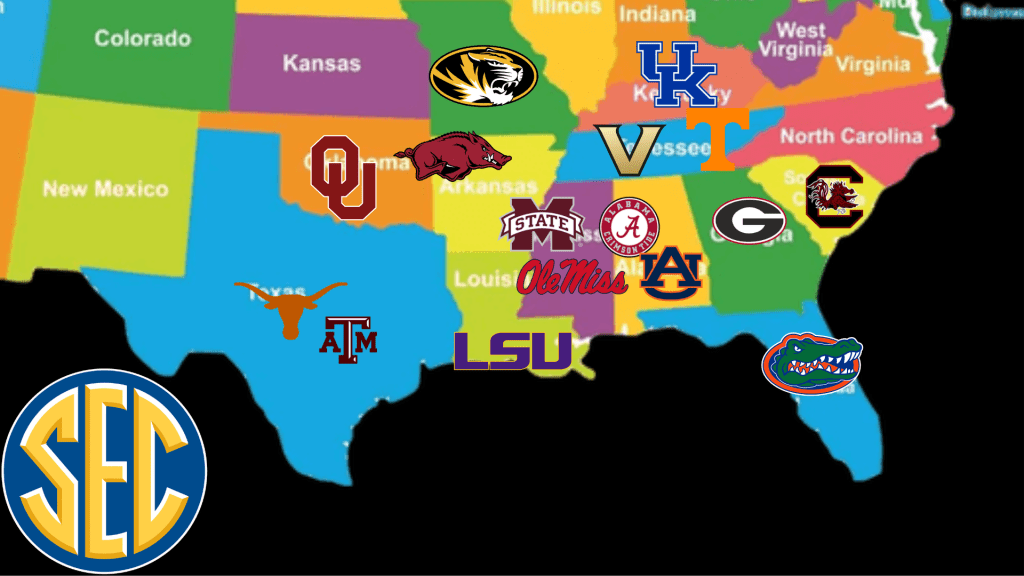
As the NCAA knows, when it comes to college football, you start with the SEC. It just means more. With Texas and Oklahoma already planning to join the SEC, getting the SEC to to 16 teams is already done. The next step is to make the divisions (or quads), four groups of four, and the winners of each quad create the SEC Final Four (NCAA already owns the trademark). Then the four teams battle for the SEC Championship and an automatic bid in the NCAA Playoffs.
Now for the quads:
SEC West: Texas, Oklahoma, Texas A&M, LSU
SEC South: Miss. State, Ole Miss, Alabama, Auburn
SEC North: Missouri, Kentucky, Arkansas, Vanderbilt
SEC East: Florida, Georgia, Tennessee, South Carolina
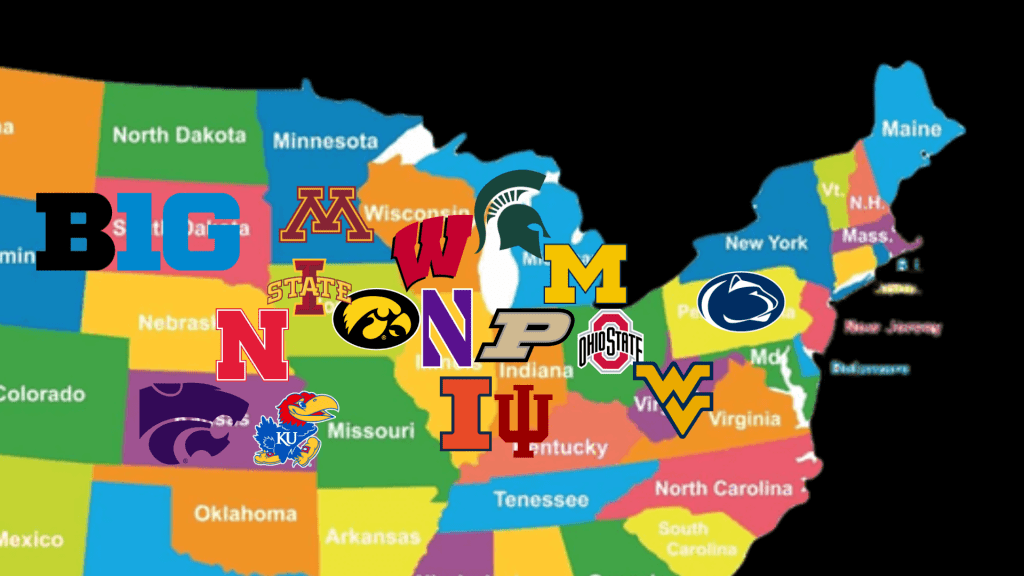
I refuse to let USC and UCLA ruin the sanctity of the regional conferences, so they are not allowed in my Big Ten. Let’s be honest, USC and UCLA are not Big Ten schools, and neither are Rutgers or Maryland. If you asked the average college football fan right now, they probably would not even know that they are already in the Big Ten. With those two out, the Big Ten needs to add four schools, West Virginia, the Kansas schools, and Iowa State (Cy-Hawk is back). This pushes Big Ten recruiting further south, while still maintaining the grit of true Big Ten football.
Big Ten West: Kansas, Kansas State, Nebraska, Iowa State
Big Ten South: Northwestern, Purdue, Illinois, Indiana
Big Ten North: Michigan State, Minnesota, Wisconsin, Iowa
Big Ten East: Michigan, Ohio State, Penn State, West Virginia
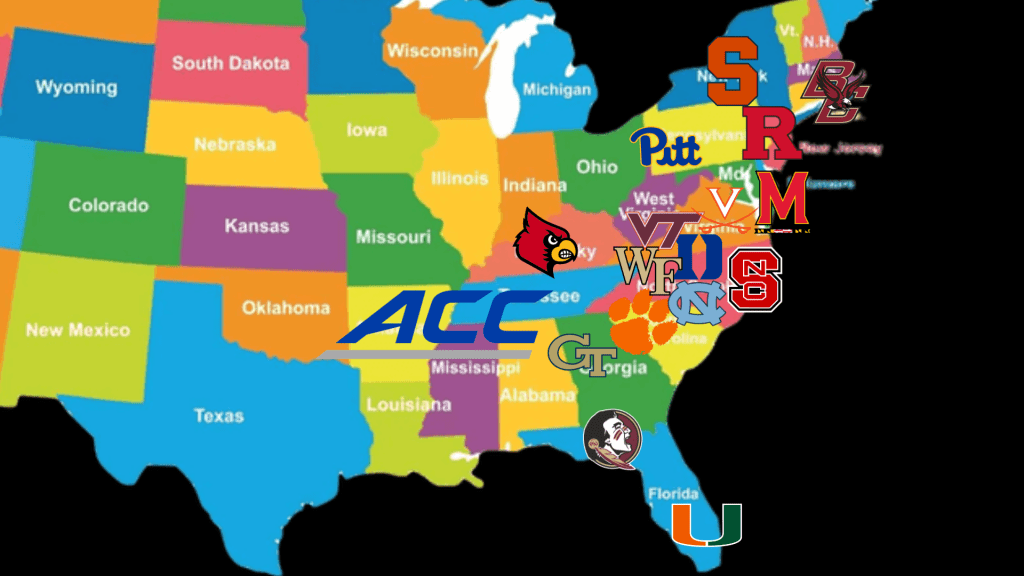
The ACC remains largely unchanged, just adding Maryland and Rutgers to the conference, giving the ACC a stranglehold on college football in the northeast. As much Georgia Tech bias as I have as an alum, the quad system really screws the Yellow Jackets over putting them with the more historically dominant teams of college football in FSU, Clemson, and the U, but that is a sacrifice that I am willing to make for the betterment of college football. The conference Final Fours will allow for the higher ranked teams to host conference semi-finals, with the championship played at respective neutral fields. For example, the ACC could have looked like this: Pitt hosting Maryland and Wake Forest hosting Clemson. Winners then play at Bank of America Stadium for the ACC Title.
ACC West: Louisville, Virginia Tech, Virginia, Pitt
ACC South: Georgia Tech, Clemson, Miami, Florida State
ACC North: Syracuse, Rutgers, Maryland, Boston College
ACC East: Wake Forest, Duke, North Carolina, NC State

Now if UCLA and USC can just be patient and let the NCAA implement my plan, then it will all work out for them, giving them the exposure they want with legitimate shots at the NCAA playoff. Playing the three teams in their quad, plus six teams from the other quads (2 from each), equals nine conference games. Each team is allowed 3 non-conference games: one against another Power-4 conference team, one against a non-Power-4 FBS team, and one buy game against an FCS team.
Pac-12 West: Stanford, Cal, Utah, Colorado
Pac-12 South: UCLA, USC, Arizona, Arizona State
Pac-12 North: Washington, Washington State, Oregon, Oregon State
Pac-12 East: Texas Tech, Oklahoma State, TCU, Baylor
Playoffs:
After all of that, here is how it will all shakedown. Four conference championship winners receive automatic bids and automatic byes as well. The remaining eight at large bids will come from the highest ranked eight teams remaining. Despite the headache and chaos that rankings have caused over the years, nothing reflects college football more than arguing about rankings with your buddies or a twitter troll online. However, it is much a much softer blow to leave out a team finishing thirteenth with two or three losses than a potential one loss conference champion in the current system. As such, the Boise States, UCFs, and BYUs of Group of 5 domination still have a legitimate chance at the playoff, but the odds rightly still favor the perennial power schools for playing harder schedules throughout the season.
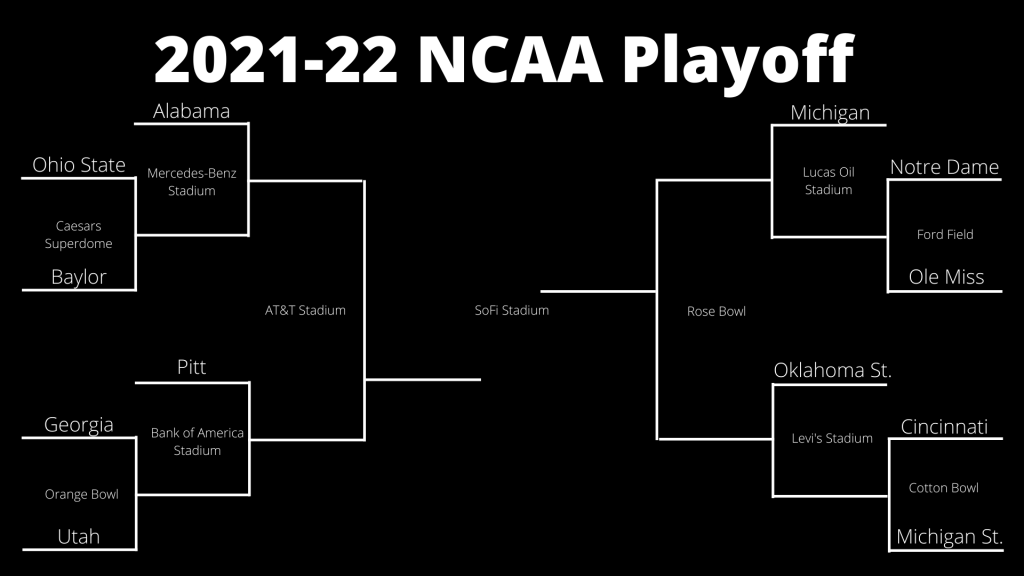
A sample bracket of what the playoff could look like is shown below. It could be static as shown, or by adding a wrinkle that the previous NCAA champion’s conference plays the winner of the 4/5, 2nd place conference plays the 3/6, and so on. For example, in the case of last year, the final rankings had Georgia first, Michigan second, Baylor fifth, and Pitt thirteenth, which means the conferences as I have constructed finished SEC first, Big Ten second, Pac-12 third, and ACC fourth, respectively.
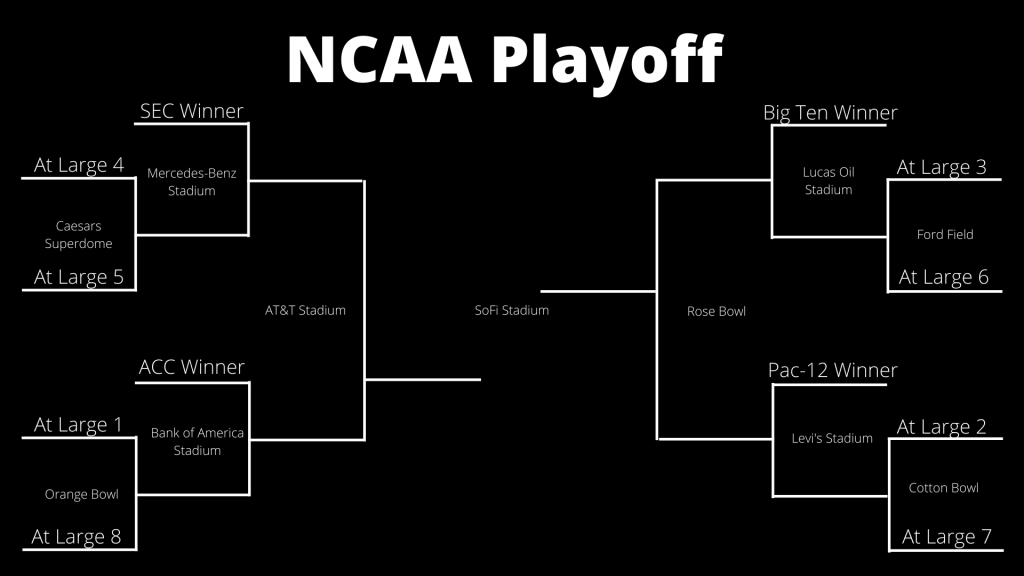
To give you an idea of how the 2021-22 Playoff bracket would have looked, it is shown below. As you can clearly see, the emphasis on conference championships remains while also giving dominant one loss non conference champions a shot too. This last year Cincinnati as a Group of 5 team still would have had a chance at the title.
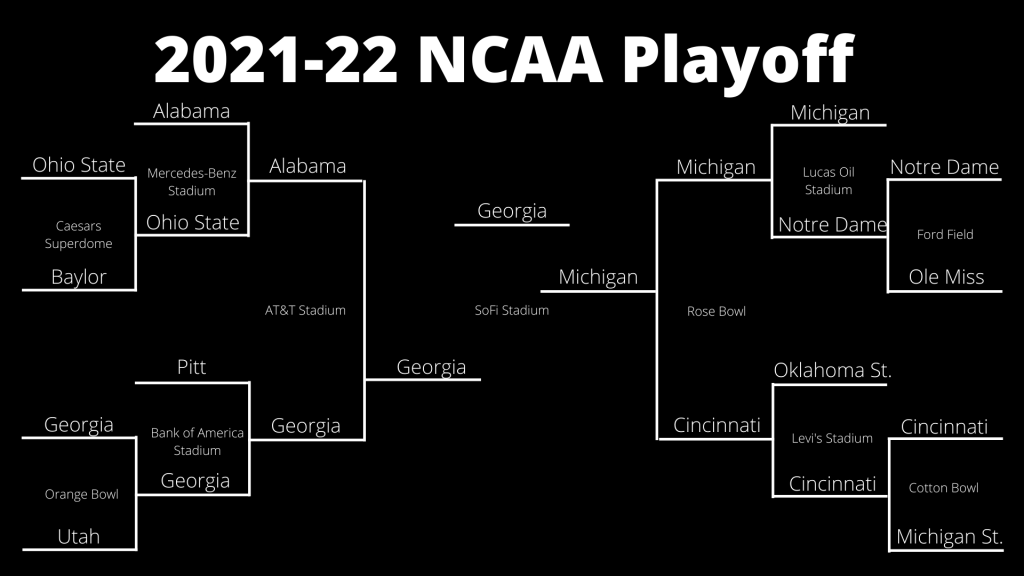
Since no real sports fan can resist filling out a bracket, I went ahead and filled in how I believe it would have played out, with Georgia remaining the national champion (more vomit-inducing words as a Georgia Tech alum).
Now, a smart college football fan may have had a question from the start. Yes, there are 64 teams in the four major conferences, but there are 65 “Power 5” teams, so what about Notre Dame? Well, great question. If you think that the NCAA and the Power 5 conferences are stubborn, Notre Dame is a whole other level. To them, I say they can kick rocks and compete for at-large bids like the rest of the country since they would still make it most years.
But money talks, so if Notre Dame wants in, we can relegate Rutgers to the AAC.
 Tyler Banning